I’ve been thinking about the accounts payable manager I walked past last week. It was 7pm, and she was staring at a stack of scanned supplier invoices that still hadn’t been touched. No one else was in the office. The pile would still be there in the morning, and she’d spend the next day doing the same thing she’d done the day before: typing numbers from one screen into another.
I’ve seen that scene too many times. The problem isn’t really that the OCR can’t read the text. It’s that the whole process, from the moment an invoice lands in the inbox to the moment it’s posted to the ERP, was never designed to work without a person. And that’s the part most teams skip when they buy software.
The True Cost of Manual Invoice Data Extraction
The numbers are brutal once you stop looking at the pile and start looking at the clock.
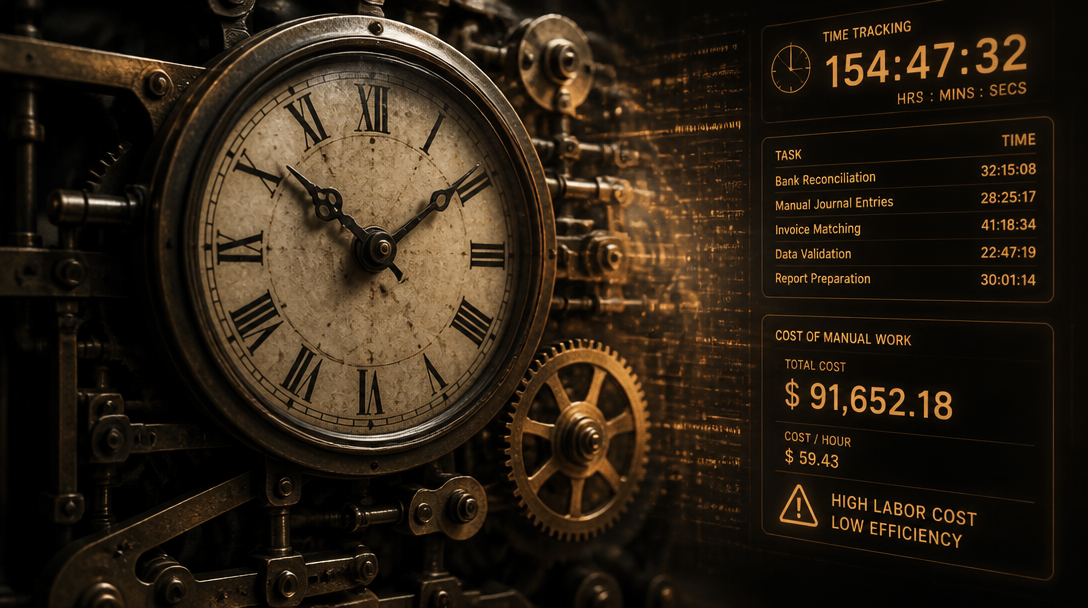
Manual invoice processing takes somewhere between 10 and 30 minutes per invoice. That’s not just data entry. It’s scanning, sorting, verifying, chasing missing information, and re-entering corrections. The cycle time averages 14.6 days from receipt to posting. For a team handling 500 invoices a month, that translates to over 200 hours of human effort every month.
The cost is equally stark. At $16 per invoice, manual processing runs about $96,000 a year for those 500 invoices. Automated processing, when done properly, can bring that down to around $2.50 per invoice, about $15,000 a year. That’s a difference that pays for itself in months, not years.
But the real cost isn’t just the money. It’s the fact that the finance team is spending its time on data entry instead of exception handling, supplier relationships, or cash flow analysis. The 14.6-day cycle means late payments, missed discounts, and a constant bottleneck that slows everything behind it.
Moving past manual entry requires understanding what automated invoice processing software actually does with incoming data and where the process still needs a human.
What Invoice Data Extraction Should Automate vs. Where Humans Belong
Invoice data extraction software hits field-level accuracy of 95 to 99 percent in production. The actual extraction step, pulling vendor name, invoice number, dates, and line items from a document, now takes a second or two per invoice rather than the 10 to 30 minutes a person needs.
That part works. The mistake is assuming the job ends there.
What I’ve observed across enough implementations is that extraction is only one stage in a longer chain. The system should be doing the high-volume ingestion, the header capture, the line-item extraction, and the initial matching against purchase orders. It should handle the repetitive work that makes a finance team want to walk out at 4pm.
But there is still an exception queue.
Missing purchase orders, price discrepancies, tax variances, duplicate records. These do not go away with better OCR. Industry data backs this up: even best-in-class automated environments run exception rates around 9 percent. Touchless straight-through processing averages closer to a third of invoices.
The invoices that sail through are the clean ones, standard formats, matched POs, known suppliers. The ones that stall are the messy ones: a supplier changed their bank details, the PO number was entered wrong, the tax calculation does not reconcile.
Someone needs to decide what to do with those.
What I see go wrong most often is a team treating the extraction tool as the whole solution, rather than one component in a workflow that still needs ownership of exceptions, validation rules, and integration handoffs. You can hit 99 percent accuracy and still have a process that breaks, because the 1 percent that fails is not random. It is the same edge cases every month, and until someone maps what to do with them, the tool solves only part of the problem.
Why an Audit-First, Fixed-Price Approach Prevents Automation Failure
Most invoice automation projects do not fail at extraction. They fail before anyone picks a tool. Industry analysis suggests nine times out of ten failed deployments skip or collapse one of four stages: ingestion, classification, extraction, and validation. The result is rarely bad OCR. It is broken validation rules and an ERP handoff that never gets designed.
An audit first forces you to map the document intake and the exception paths before you commit to a platform. You see which suppliers always send inconsistent layouts, which purchase orders never match, which approvals stall. That map becomes the build spec.
Fixed price matters for a specific reason. It removes the incentive to expand scope after discovery and keeps deployment costs predictable instead of open-ended. No lock-in keeps the process yours. I would rather price the work after we know what we are dealing with, not before.
What I keep returning to is simpler. A fixed price only works if the audit was honest. Skip the floor walk and you are buying extraction, not automation. Map the process properly and the tool becomes a detail.
Then the efficiency gains become predictable, not hoped for. That is the part worth getting right.
If you are about to buy extraction software, map the workflow first. Walk the intake path, the exception routes, the handoff points from finance to ops and back again. The tool can wait. The floor walk cannot.
I will show you a real example next week: a finance team that cut their month-end close by three days without touching a single integration, simply because they documented the process before they bought the platform. That is the order that holds up.