Picture a Monday morning service reception desk where three phone lines ring simultaneously, two clients stand waiting at the counter, and a provider sits idle in a booked room because a client forgot their morning slot. That empty chair is not a scheduling hiccup. It is a revenue leak, paid in full by the business, and it repeats itself across appointment books nationwide far more often than most owners realise.
Missed appointments are a silent tax on service revenue. Across appointment-based industries, no-show rates commonly land between 20% and 25%, with one aggregated analysis across 105 studies putting the average right around 23%. Manual reminder calls and front-desk phone tag do almost nothing to move that number, because the approach is reactive, inconsistent, and dependent on staff bandwidth that rarely exists when it is needed most. The shift that actually changes attendance rates begins with automated reminders, but it does not end there. It ends with a fully autonomous scheduling workflow that removes the operational friction from the entire booking lifecycle, from first inquiry to post-appointment follow-up.
The Hidden Tax of No-Shows on Service Revenue
For service businesses, the no-show burden is less dramatic than the 23% headline figure would suggest, but its financial bite is often sharper because margins are tighter. First-time visits commonly see no-show rates between 8% and 15%, and even repeat clients miss at 5% to 10%. Those rates do not sound catastrophic until you do the math on a quiet Tuesday.
A solo practice booking 20 appointments a day at £150 each loses £300 in revenue by lunch when just two clients skip. Multiply that kind of leakage across a week, factor in the idle provider time, the front desk hours spent on rebooking calls, and the domino effect on the afternoon schedule, and a 10% no-show rate turns into a six-figure annual haircut. The core problem is that manual reminder calls do essentially nothing to prevent this. They are reactive, they depend on staff bandwidth that does not exist when the schedule is open, and they hit the wrong channel at the wrong moment.
Automated workflows reverse that dynamic. Instead of chasing after the fact, they intercept the no-show before it happens by changing the timing, the channel, and the client’s ability to respond in seconds.
How Automated Reminders and Multi-Touch Sequences Cut No-Shows
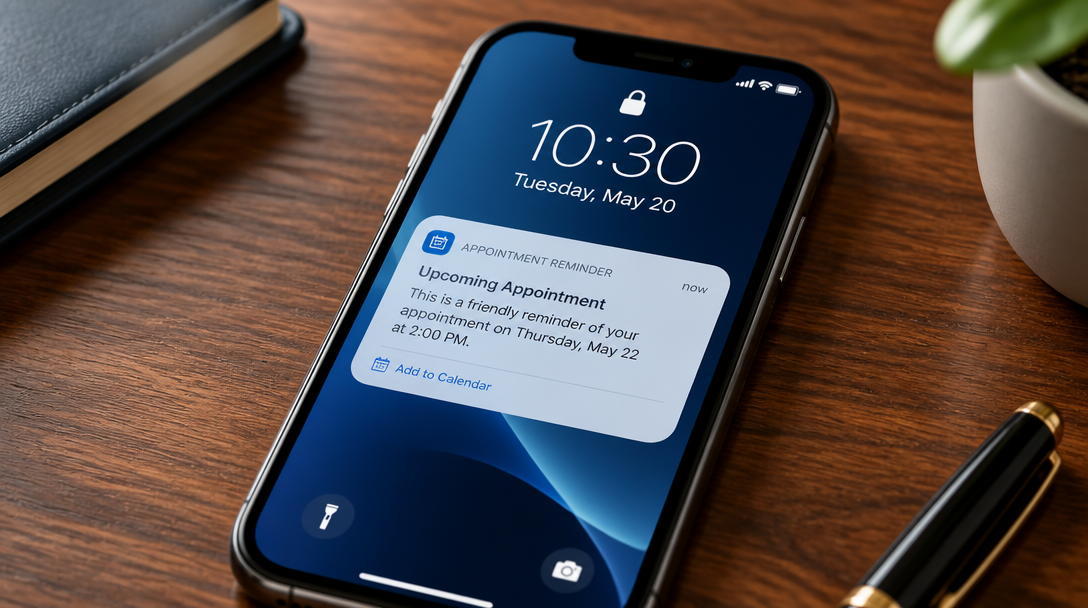
Automated reminders work because they change the timing and channel of outreach. A body of evidence from 2022 to 2026 shows that switching to automated reminders reduces no-shows by roughly 38% on average. When businesses layer multiple channels, SMS, email, and sometimes voice, and send two or more touches at different intervals before the appointment, the reduction climbs to 50% or even 70%.
The mechanism is straightforward. A single text message sent a day before an appointment cuts no-shows by 7% to 11% in clinical settings. Adding a second reminder several hours before, along with a one-tap link to confirm or reschedule, turns a likely no-show into an early cancellation that can be filled from a waitlist. SMS is the most effective channel because it is seen within minutes, unlike email, which is often buried.
Reminders are not a silver bullet. In studies where staff personally called patients, no-show rates were lower than with automated messages alone. But the operational cost of that approach is hard to scale. The sweet spot for most service businesses is a multi-touch automated sequence that includes a simple rescheduling option, which catches the majority of clients who would otherwise forget.
The reminder is only the final defence. To capture the full benefit, the upstream booking architecture must be equally automated.
Anatomy of an Autonomous Scheduling Workflow
Modern autonomous scheduling systems break booking into discrete steps, each handled by a specialised function rather than one monolithic script. The result is a faster handoff from inquiry to confirmed slot, and a predictable process that catches conflicts before they reach a staff member’s inbox.
The workflow typically begins with intent detection. A client fills out a form, sends a message, or initiates a chat, and the system immediately classifies the request as a booking attempt rather than a general question. From there, a calendar lookup agent pulls live availability across relevant providers, rooms, and equipment. When the first available slot conflicts with an existing hold, a conflict resolution step proposes alternatives or applies pre-set priority rules without pausing for human approval.
Confirmation generation and dispatch follow directly. The system locks the slot, sends the invite, and queues the first reminder as soon as the booking is finalised. A demo-booking automation deployment reported a 73% reduction in time from request to scheduled appointment and a 32% increase in booking completion rate by removing the manual back-and-forth that typically sits between those steps. The same case study credited smarter, earlier reminders with a 22% higher show-up rate.
High-performing implementations do not treat the workflow as fire-and-forget. A healthcare case study showed that mapping every manual scheduling step first, then separating what could be fully automated from what needed human review, produced a system that handled routine bookings end-to-end while flagging only genuine exceptions to staff. Another deployment organised the logic into separate agents for monitoring triggers, processing booking rules, and executing actions across connected platforms, with notifications landing in Slack rather than a crowded inbox.
The architecture matters because the failure points are predictable. A single missed conflict check cascades into double bookings. A reminder sequence that fires late loses its chance to convert a no-show into a reschedule. Breaking the workflow into discrete, monitored steps makes each failure point visible and fixable before it reaches a client.
These autonomous workflows reach their full operational value when they plug directly into the platforms a business already runs on.
Connecting Autonomous Booking to Existing Operational Stacks
Autonomous scheduling delivers its hardest returns when it stops being a standalone tool and becomes a layer across the platforms the business already runs on. The healthcare case study that mapped manual scheduling into discrete automated steps did not build a replacement for the clinic’s existing systems. It pulled live availability from those systems, applied decision logic, wrote confirmed appointments back to the calendar, and notified staff in Slack. The automation sat on top of the stack, not next to it.
That architecture matters because fragmentation is what makes manual coordination expensive. When a scheduler toggles between a calendar, a CRM, a billing tool, and an email client to complete a single booking, each handoff is a place where time leaks and errors enter. An autonomous system that reads and writes across those same endpoints eliminates the toggling without asking the business to rip anything out.
The pattern across deployments is consistent. Legal workflows integrate with case management and document tools. Finance workflows connect billing, payments, and messaging platforms. Real estate setups route through calendar and messaging APIs. In every case, the automation layer inherits the existing tooling rather than demanding a migration. The operational advantage comes from keeping the systems the team already trusts and removing the labour cost of moving data between them.
The cost of manual scheduling is not found in a line item. It shows up as no-show revenue that never recovers, as staff hours burned on phone tag and data entry that could fuel growth work, and as the ceiling on how many clients a team can serve before the coordinator becomes the bottleneck. Autonomous booking workflows strip that cost out by sitting on top of the tools already in place, reading availability, writing confirmed appointments, and managing multi-channel reminders without a human handoff. The result is a scheduling function that does not break when volume spikes, does not miss the reminder window, and does not require another hire to keep pace.
For service business leaders, the calculation is straightforward. Fewer no-shows means recovered billable hours that were already on the books. A booking layer that operates across the existing calendar and communication stack means the team serves more clients without adding coordination overhead. What starts as a workflow automation project ends as a capacity advantage, a tighter bottom line, and a client experience that never asks someone to call back tomorrow.