I’ve been thinking about this a lot lately: how many genuinely happy customers quietly slip out the door every single week, not because anything went wrong, but simply because nobody asked them for a review at the right moment.
Most businesses have no idea. They rely on a monthly email blast or a generic follow‑up that lands three days after the interaction, long after the glow has faded. The customer was thrilled on Tuesday. By Friday, they’ve moved on. The window closed.
But here’s something I keep coming back to, and I might be wrong about this, but I really don’t think I am: the businesses pulling ahead on reputation in 2026 are not the ones with the best product or the most attentive service team. They’re the ones who built a system that catches satisfaction at its peak and routes it somewhere useful before the moment evaporates. Manual follow‑up can’t do that. It never could.
Why Traditional Survey Follow-Ups Fail
External surveys in 2026 mostly land in the 5% to 15% response range. Email-only versions often sit below 10%. For every hundred people you ask, you’re lucky to hear from ten.
That’s the quiet failure nobody budgets for.
Survey programmes also take two to six weeks to turn feedback into insight. By then, the promoter has forgotten what being thrilled felt like. The review you might have earned has become another unread email.
I’ve watched this exact lag kill more review programmes than bad products ever did.
But here’s the part that matters: sending feedback requests within 24 hours of service completion can produce three to five times higher CSAT response rates than surveys sent after 48 hours. Timing is not a nice‑to‑have. It is the entire mechanism.
Manual follow‑up is structurally incapable of hitting that window. A person has to remember, find the customer, and press send. A trigger does it instantly.
That sets up the obvious next question.
Turning NPS Promoters Into Public Reviews Instantly
Here’s what automated routing actually changes.
A customer gives you a 9 or 10 in an NPS flow. Instead of ending at a thank‑you page, the system immediately identifies them as a promoter and acts while the enthusiasm is still live.
The request is not the scheduled broadcast you send whenever the list next goes out. It is a prompt or redirect inside the same journey, straight to Google, Trustpilot, G2, or whichever platform carries weight for your business.
That shift changes the numbers considerably. NPS-triggered review requests convert roughly 15% to 30% of triggered promoters. Generic email campaigns sit at 3% to 8%. You are not just asking more people. You are asking the right people at the exact moment their satisfaction is highest.
A franchise automation vendor reported 847 surveys sent in a month, a 62% response rate, and 38 promoters routed to Google. That is not exceptional software. That is what happens when you remove the delay between feeling and action.
The system makes the decision cleanly: a high score goes outward. A low score goes somewhere else entirely.
While promoters are channelled outward, negative feedback requires an entirely different automated treatment.
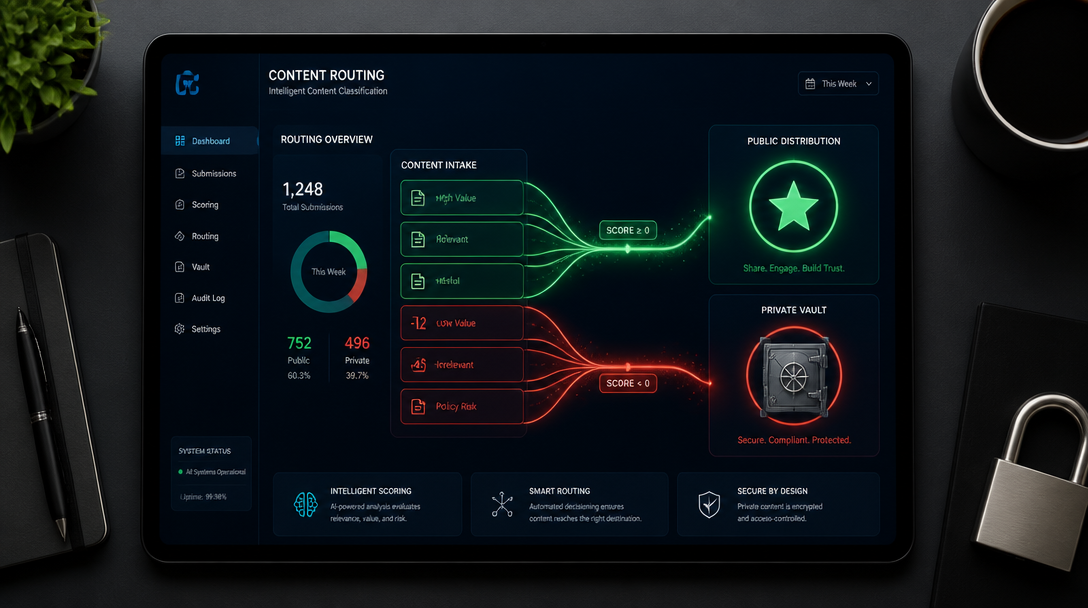
Intercepting Negative Feedback Before It Goes Public
A low score hits the system. Instead of sitting in a dashboard for a week, it triggers an immediate private follow‑up.
That shift changes the outcome completely.
Automated workflows intercept negative feedback privately 60% to 80% of the time. Manual processes sit at 5% to 10%. The gap is not about effort. It is about speed. By the time a human sees the complaint, the customer has already told ten other people. The system gets there before any of that happens.
In practice, the unhappy customer gets a short message, a real apology, and an open line. The complaint becomes a ticket, not a public one‑star review. Containment is the real win.
Still, automating every layer of that interaction runs into a hard limit when trust is the asset you are trying to protect.
Where Automation Should Stop and a Person Should Start
Automated routing works cleanly for scores. A 9 triggers this. A 6 triggers that. The decision tree is straightforward.
The reply itself is a different story. A templated apology to a frustrated customer reads exactly like what it is. The moment a message feels automated, the recovery it was meant to deliver falls apart.
I might be wrong about this, but the split that actually holds up is roughly this: automation handles routing, timing, and triage. A person handles anything with real stakes attached, whether that’s a complaint, a key account, or a request that doesn’t fit the decision tree.
That’s the same rule we apply to every workflow we build. Understand what a human needs to see before you automate the rest. Automating everything, including the parts that carry relationship risk, is how a review programme quietly breaks the exact trust it was meant to protect.
The businesses pulling ahead are not the ones who automated the most. They are the ones who automated everything that could be automated, then applied judgement to the parts that carry real weight.
Automation handles the grunt work. Trust still needs a human signature.
The predictable growth loop is this: a promoter hits submit at peak satisfaction, the review routes to your public profile, and the next prospect sees it. Every time a manual follow‑up email gets missed, that loop breaks. No one notices the gap until a competitor with twenty more recent reviews starts pulling ahead.
Audit your current follow‑up gaps. If you would not bet actual revenue that every satisfied customer is asked for a review within twenty‑four hours, you have a gap worth closing. Automation handles the asking, the timing, and the routing. The credibility part is still yours. But the first step is being honest about where the manual process is leaking.